
PCCJ Release Paths
Pruntytown Correctional Center and Jail is a WVDCR state correctional center, not the Taylor County jail. It houses adult men in minimum and medium custody. Its residents are sentenced state prisoners, so the prison side of the West Virginia offender search is the proper live route. The regional-jail search is intended for facilities such as TVRJCF and should not be used as the main source for a PCCJ prisoner.
A prisoner may leave PCCJ on parole, at discharge, through a conditional or mandatory release plan, or by transfer to another WVDCR facility. Parole changes prison confinement into supervised community status under conditions. Discharge marks the end of the sentence status described in the WVDCR record, though a distinct case or legal duty may still exist. A transfer ends the PCCJ placement but continues custody.
| PCCJ event | What follows | Record to obtain |
|---|---|---|
| Parole | Community supervision through WVDCR Parole Services | Board action and actual WVDCR release |
| Sentence discharge | Custodial sentence ends as recorded | Release transaction and discharge certificate |
| Conditional release | Release under the applicable WVDCR plan | Plan, status, and actual event date |
| Institution transfer | State custody continues elsewhere | Movement record and new location |
Search PCCJ Release Status
Start with the WVDCR DOC offender search. Enter first and last name, complete the human-verification step, and compare results with date of birth, OID, photograph when available, and location. Open “More Info” only after matching the person. The public record may display a projected release date. That date is not an appointment, a Parole Board decision, or proof that release occurred.
A fully discharged person may stop returning in the active search. “No results found” is therefore not a discharge record. Save a relevant result near the event, preserve its retrieval time, then request the release or discharge fields from WVDCR. If parole is involved, obtain the Board action as well. Eligibility and a grant each precede the actual facility departure, and a grant can still depend on conditions.
- Choose the prison search, not the regional-jail search.
- Search the full legal name and compare several identifiers.
- Open “More Info” and record the location, status, and projected date exactly as shown.
- Check Parole Board material if parole is the expected release route.
- Request WVDCR’s actual release, discharge, or transfer record.
PCCJ Projected Release Dates
WVDCR operations use Minimum Discharge Date, often shortened to MDD, for a final-release projection based on continuous incarceration and expected credit. The public locator uses the phrase “projected release date.” Neither phrase means parole eligibility. Parole eligibility is the point when the Board may consider release, not a right to leave prison.
West Virginia’s good-time rules can affect the calculation. Eligible time in physical custody can earn statutory commutation, while disciplinary loss, later restoration, sentence correction, jail credit, new or consecutive terms, escape time, and other lawful events can change the total. The law does not create a general state rule that every prisoner serves a fixed percentage. Each calculation must be read from the individual judgment and WVDCR computation statement.
- Projected release date
- A forecast based on the current sentence calculation.
- Parole eligibility
- The first point for possible Board consideration, not promised release.
- Actual release
- The recorded event when the person leaves physical prison custody.
- Discharge
- The later or separate end of the sentence or supervision status shown.
Request PCCJ Release Records
WVDCR Central Records is the safe formal route for a PCCJ incarceration episode. Policy Directive 142.00 identifies release date and time, parole eligibility, projected minimum discharge, good-time allowance, mandatory release, discharge method, destination, transfer destination, time served, and the file photograph among potentially public information, subject to legal limits. Specify which fields matter and identify the exact episode.
A request should include the prisoner’s full name, aliases, date of birth or OID, PCCJ placement, Taylor case number if relevant, and approximate custody period. Ask for the existing electronic release or movement record, not an explanation that the agency must create. Request the release date and time, method, authority, destination category, projected and final discharge dates, and discharge from supervision when applicable. Invite lawful redaction and production of all nonexempt parts.
WVDCR FOIA and Subpoena SupportAttention: FOIA Coordinator
1409 Greenbrier Street
Charleston, WV 25311
Phone: 304-558-2036
Arrange records inspection with the office.
West Virginia FOIA permits actual reproduction costs but does not authorize a search, retrieval, or staff-time charge under the cited request section. No set PCCJ photo fee was verified. Ask for an estimate before costs are incurred. A Taylor court judgment can explain the sentence, but WVDCR calculates credits and records the physical event.
PCCJ Release Mission History
Pruntytown’s institutional history is distinct. The site began as the Industrial School for Boys in 1891, closed that juvenile role in January 1983, and reopened for adults in 1985. Current WVDCR material governs its modern role. The old mission must not be used to infer who is held there now or how present releases work.
Today PCCJ houses minimum and medium custody adult men. WVDCR reports capacity for 369 residents. Its annual-report mission says residents are generally within 36 months of parole or discharge. That placement focus makes release-date questions common, but “within 36 months” is not a promise. The individual sentence calculation, Board action, conduct, detainers, and transfer decisions still control.
The official PCCJ facility page provides the present role and records contacts shown in the captured source below.
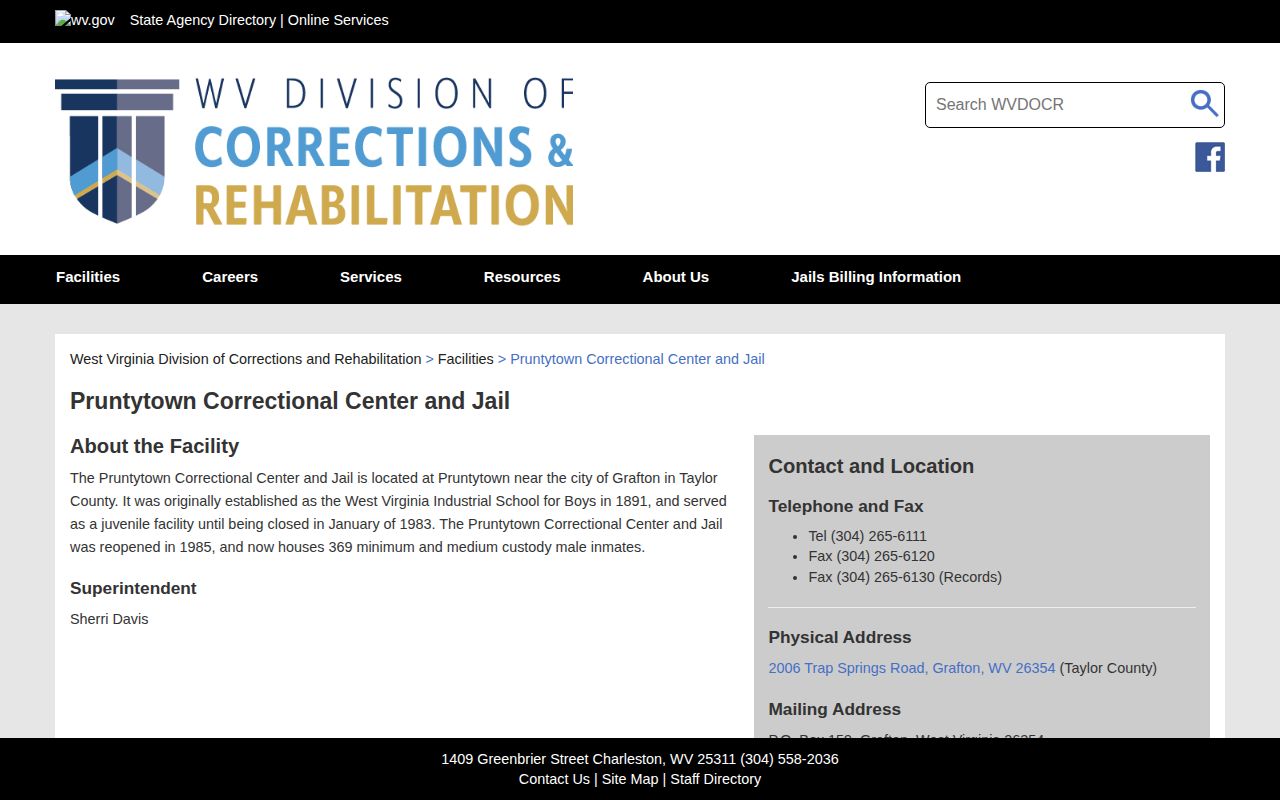
The facility source confirms PCCJ’s state-prison context. It does not turn a projected date into an actual release record.
PCCJ Parole Release Proof
The West Virginia Parole Board makes parole decisions independently of WVDCR. Its calendar and hearing material can show the institutional schedule, but no complete public person-by-person decision database was found. A Board grant means release may occur after required conditions are met. It is not the time that a person walked out of PCCJ.
Keep four dates separate: parole eligibility, Board decision, actual release from PCCJ, and later discharge from parole supervision. A denial keeps the person incarcerated and sets later review as allowed. A “set-up” is another hearing stage. A grant can be deferred or rescinded before actual release under qualifying circumstances. WVDCR’s event record resolves when physical custody changed.
After community release, Parole Services handles field supervision. Federal supervised release and Taylor probation are separate systems. If the event code shows parole on detainer, the person may have moved directly to another hold rather than entering the community.
PCCJ Release Travel Plans
WVDCR policy addresses transportation when a prison release lacks other arrangements. It can involve transport to the nearest bus location and one-way fare, normally using mandatory savings with state coverage for a shortfall. An alternative may be the courthouse in the county seat of last commitment or an approved parole-plan location when closer. The actual plan must be confirmed with PCCJ.
This policy does not publish a routine exit hour or guarantee a route. A projected date can move, and release conditions can delay departure. Personal property also needs prompt attention. WVDCR admission policy warns that property left after release may be disposed of after 30 days, so the former prisoner should ask the facility for current return instructions without assuming a pickup process.
PCCJ Release Contacts
The general facility line can route questions about permitted status information. The records fax can help direct a request, while central WVDCR remains the formal custodian route. Provide enough identifiers to avoid a same-name error. Staff may restrict protected or operational facts, so ask for the public record rather than informal details.
Pruntytown Correctional Center and Jail2006 Trap Springs Road
Grafton, WV 26354
Mail: P.O. Box 159, Grafton, WV 26354
Phone: 304-265-6111
Fax: 304-265-6120
Records fax: 304-265-6130
A sound conclusion combines the last confirmed PCCJ status, the sentence or Board authority, WVDCR’s actual transaction, the destination category, and any later supervision discharge. No single missing web result supplies that whole chain.
PCCJ Evidence Review
Review a PCCJ release through four separate stages: the sentence, the WVDCR computation, any Parole Board decision, and the actual transaction. A court judgment describes the term. WVDCR applies credits and calculates the projected date. The Board decides parole. Central Records supplies the event that confirms departure or transfer.
Good time can change through loss, restoration, correction, jail credit, consecutive terms, or other lawful events. WVDCR’s computation statement is therefore more useful than a general rule of thumb. West Virginia does not have a researched blanket rule that every state prisoner serves the same fixed percentage. Read the individual record.
Parole eligibility is only the point for possible consideration. A hearing can lead to denial, another hearing stage, or a grant subject to conditions. Even a grant is not the PCCJ gate time. Keep eligibility, decision, actual release, and later discharge from parole as four dates.
When a prisoner transfers, record the new WVDCR site. A transfer is not parole or discharge. If a detainer sends the person to another authority, the destination record should be checked separately. The agency code and plain-language meaning help prevent a move from being reported as community release.
Identity checks remain essential. Match name, date of birth, OID, location, photograph when shown, and sentence context. Preserve the last public result because full discharge may later produce no match. Then obtain the official record rather than relying on a saved screen alone.
The Parole Board guidance helps distinguish the minimum discharge date from parole action, while the WVDCR policy index supplies the official release-policy route. The Taylor County search and release-record hub connects PCCJ records with court and supervision sources.