
Taylor County Projected Release Dates
WVDCR’s public-facing term is projected release date. Its operating policies use Minimum Discharge Date, often shortened to MDD, and Final Release Date. The Taylor County calculation assumes continuous incarceration and expected sentence credit. It is not an actual release timestamp, a guaranteed pickup time, or necessarily the date a person first becomes eligible for parole.
The West Virginia Parole Board defines MDD as the date an inmate can expect release from WVDCR custody if the person is not paroled, does not escape, and does not lose good time. Policy Directive 454.10 uses the same basic assumptions. If one assumption changes, the computed Taylor County date may change too.
A Taylor County pretrial detainee usually has no comparable prison projection. Bond, a dismissal, a plea, a court order, time served, or later sentencing may control the outcome. A Taylor County court order can authorize release before TVRJCF finishes processing, and another hold can stop a community release. Keep the legal order and physical event separate.
Taylor County Release Date Paths
Taylor County has two locally important routes. A local arrest normally leads to Tygart Valley Regional Jail and Correctional Facility, a state-operated regional jail in Randolph County that serves Taylor. Pruntytown Correctional Center and Jail sits in Taylor County but houses a state correctional population. The first route relies on the RJA current search and Taylor court documents. The second relies on the DOC offender search and the WVDCR sentence computation.
| Custody path | Best first source | Date meaning |
|---|---|---|
| Pretrial at TVRJCF | RJA status plus Taylor court docket | Often no fixed release date; bond and court action control |
| Short jail sentence | Judgment, jail credit, and WVDCR record | Sentence calculation may apply, but the prison search field may not |
| PCCJ or another state prison | DOC search “More Info” and WVDCR computation | Projected date is provisional until actual release |
| Parole candidate | Board action plus WVDCR status | Eligibility and a grant are not the gate-release time |
| Federal or immigration custody | BOP or ICE system | State projected-date rules do not govern |
Do not search only by county name. A Taylor County case can appear under TVRJCF outside the county, while a person at PCCJ may have been sentenced elsewhere. Match identity, case, system, and facility.
Find Taylor County Projected Release Dates
Gather the full legal name, spelling variants, date of birth, OID if known, Taylor County case number, sentencing court, and last known facility. Use the jail and prison sides of the state system when the custody level is uncertain. A missing result is not proof of release because a fully discharged person may no longer return in the public search.
- For a Taylor arrest at TVRJCF, check the RJA offender search for present custody. Then locate the Magistrate or Circuit Court case that controls bond or sentence.
- For PCCJ or another state prison, use the DOC offender search. Open “More Info” and copy the exact projected-release label and displayed date.
- Compare more than the name. Confirm date of birth, location, OID, court, and case details before treating the result as the same person.
- Obtain the judgment and any later order. Ask WVDCR for the current sentence and minimum-discharge computation statement when its custody applies.
- Record the search time and source. After the forecasted date, obtain the release or movement event to learn whether the person entered the community or another custody system.
The full Taylor County release-record path can help reconcile court authority, custody status, and the agency transaction.
Note: “No results found” can reflect discharge, a mismatch, or timing and must not be converted into an unsupported release date.
Taylor County Good-Time Computation
West Virginia Code §15A-4-17 governs good time for eligible adults in the Commissioner’s custody. Good time is a sentence commutation, which means credit deducted from the maximum term of an indeterminate sentence or the fixed term of a determinate sentence. The statute provides one day for each day physically incarcerated, including qualifying presentence jail time credited under state law. It does not award that good time for time on parole, bond, or another status outside physical incarceration. Life sentences do not receive good time under the cited subsection.
The official good-time statute is available from the West Virginia Legislature.
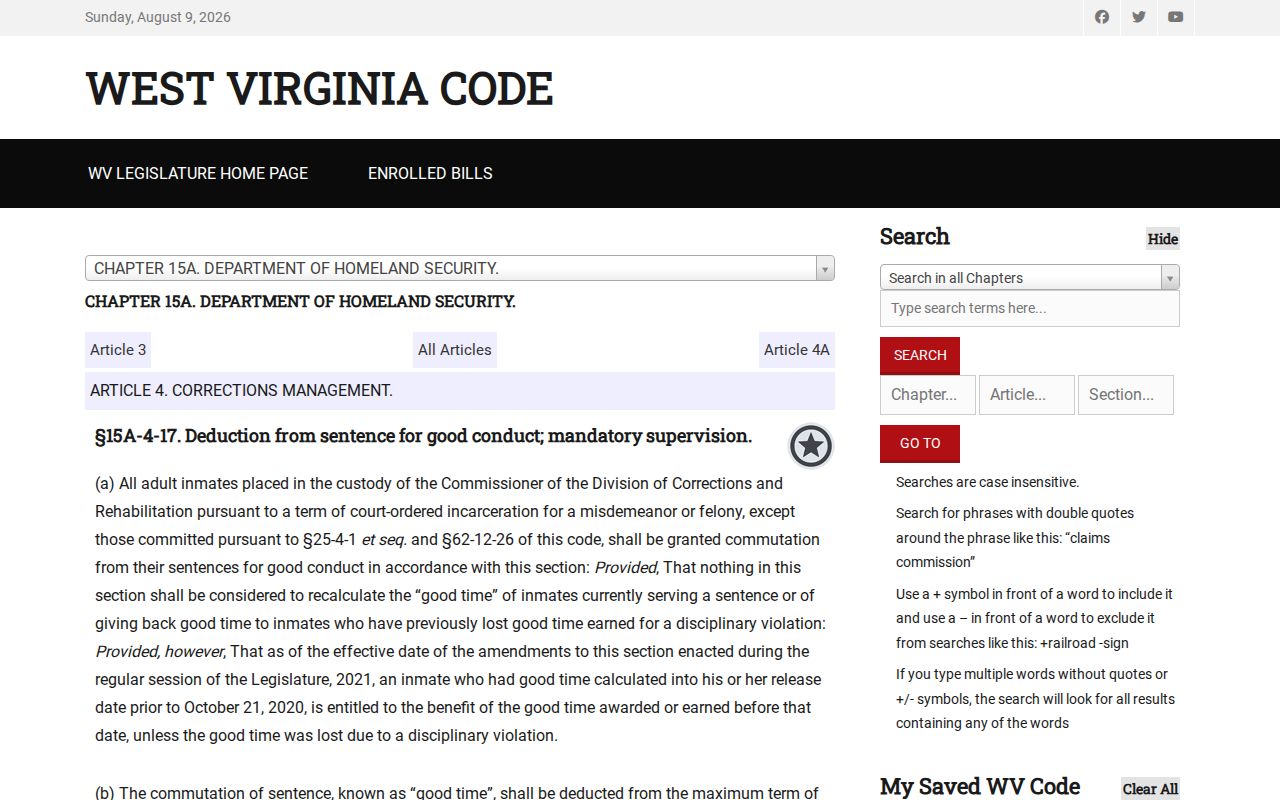
The statute supplies the statewide rule that WVDCR applies to an individual sentence, not a ready-made Taylor County release date. Good time may be forfeited or revoked for discipline and may be restored with approval. WVDCR must provide a Taylor County sentence or minimum-discharge computation statement and revise it when credit changes. Additional good time may be available for meritorious service and, for eligible felony inmates, an approved nonrequired academic or vocational program. Each item must be supported in the person’s own computation.
A Taylor County computation request should name the judgment, sentence start, credited presentence jail time, full-term expiration, good-time allowance and rate, projected minimum discharge, mandatory-release date, and any later revision. WVDCR Policy 142.00 identifies these as release-related public fields, subject to applicable law. Those field names help the records office locate an existing document without being asked to perform a new calculation. If the court judgment and agency statement disagree, preserve both dates and ask whether a correction, later order, or data lag explains the difference.
Taylor County Has No 85% Rule
No general West Virginia rule requires every state inmate to serve about 85 percent of a sentence. That federal shorthand should not be imported into a Taylor County WVDCR calculation. Taylor County sentence review uses the state good-time framework, sentence structure, statutory exclusions, jail credit, consecutive terms, discipline, and other lawful changes.
The one-for-one provision also should not be reduced to a promise of Taylor County release at half the sentence. Eligibility and the actual calculation can be more complex. The judgment may include more than one count or term. Some time may not qualify. A new sentence or corrected jail credit can alter the base. WVDCR’s written computation is more reliable than an estimate made from a docket line.
- Determinate sentence
- A fixed term set by law and the court.
- Indeterminate sentence
- A sentence stated with minimum and maximum terms.
- Jail credit
- Qualifying time in custody credited toward the sentence.
- Dead time
- Time that does not count toward the sentence under the governing record.
- Detainer
- A request or hold from another authority that can prevent community release.
Taylor County Conditional Release Dates
Taylor County good-time computation can connect to a later term of mandatory supervision. For specified offenses committed within the statute’s scope, §15A-4-17 deducts part of accumulated good time to create a year of mandatory post-release supervision. For other felonies, the sentencing court may direct a shorter mandatory term within the statutory limit. These provisions affect the custody and supervision timeline, so “release date” may mark a move from incarceration to supervised status rather than the end of all control.
West Virginia Code §15A-4-17a separately permits WVDCR to create a mandatory supervised-release plan for certain felony inmates who were not paroled. The person is treated as released on parole for that period and may be returned for a violation.
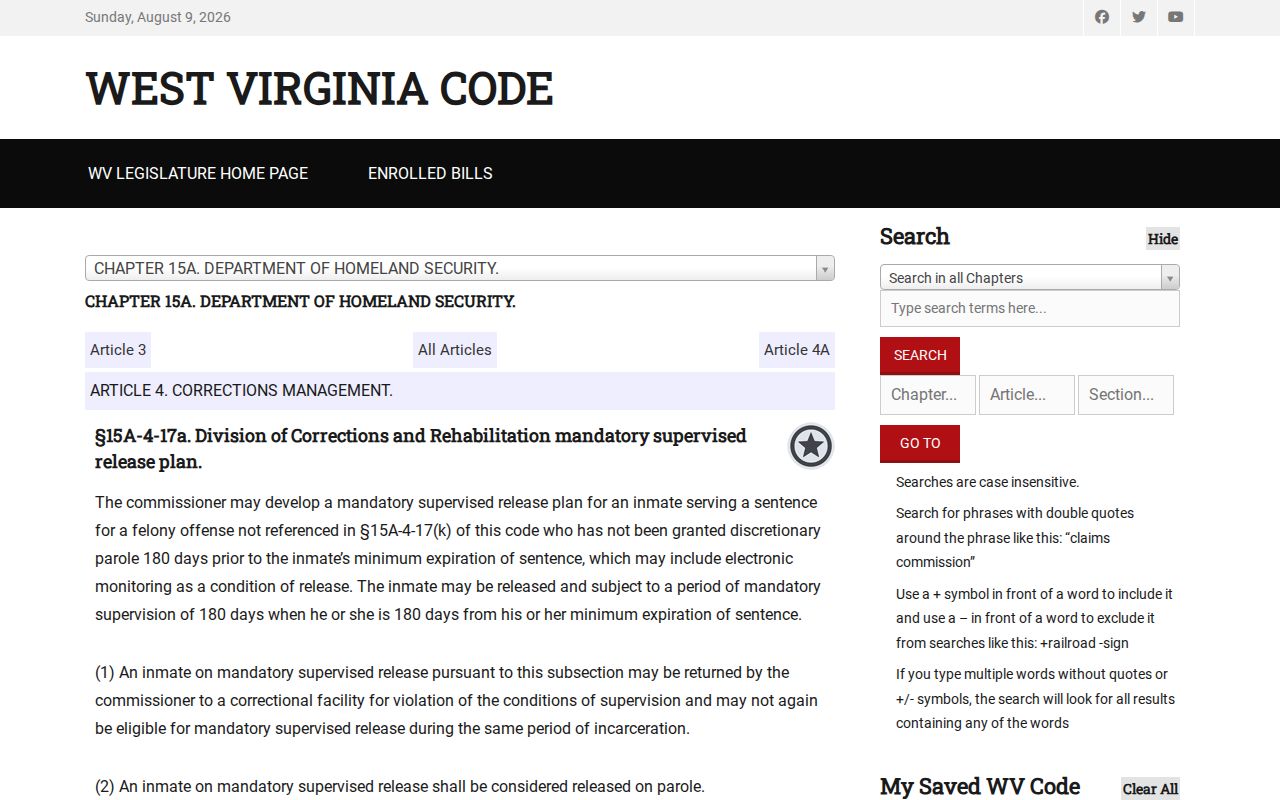
The conditional-release statute shows why the end of confinement and the end of supervision need separate entries in a release record.
The Taylor County custody record should preserve the agency’s actual release code. WVDCR reporting distinguishes discharge, parole within West Virginia, parole out of state, parole on detainer, court-order release, and court-order release to a community corrections program. “Parole on detainer” is especially important because one sentence may reach its release point while another authority keeps the person in custody. A displayed date without the release method and destination category is therefore incomplete.
Taylor County Release Date Changes
A Taylor County projected date can move earlier or later for a documented reason. Some changes come from sentence math. Others come from a new legal event or a decision about parole. Ask for the revised computation and the source record rather than guessing which factor applied.
| Factor | Possible effect | Record to check |
|---|---|---|
| Good-time loss or restoration | Moves the computed minimum discharge date | WVDCR computation and discipline record where releasable |
| Jail-credit correction | Changes credited time | Court order and revised WVDCR statement |
| New or consecutive sentence | Extends or restructures the term | Judgment and sentence calculation |
| Escape or dead time | Removes time from the count | WVDCR computation |
| Parole decision | May allow release before minimum discharge when conditions are met | Parole Board action and release event |
| Detainer or other hold | May turn a planned community release into a transfer | Movement record and holding authority |
| Court modification | Changes the lawful sentence or release authority | Filed court order |
Note: A parole grant can still be delayed, rescinded, or conditioned, so it should never be substituted for the actual WVDCR release timestamp.
Taylor County Parole Date Differences
Four Taylor County dates may matter for a person at Pruntytown or another WVDCR prison: parole eligibility, a Board interview or decision, actual prison release, and later discharge from supervision. Eligibility means the person may be considered. It does not create a right to leave on that date. A grant also may depend on a verified release plan or other conditions.
The Parole Board MDD information explains the minimum-discharge concept.

The Board resource is useful for Taylor County definitions, while WVDCR holds the person-specific computation and release transaction.
Confirm Taylor County Actual Release
Near the Taylor County projected date, check the correct WVDCR system and the controlling court case. Register for a specific-person event through the Taylor County VINE inmate check when the record offers notification. VINE can provide a prompt status alert, but its event must still be confirmed through the agency that supplied the Taylor County record.
For TVRJCF, call 304-637-0382 and ask which office can supply public release or movement information. For PCCJ, call 304-265-6111; its published records fax is 304-265-6130. A formal request may need to go to WVDCR Central Records at 1409 Greenbrier Street, Charleston, WV 25311. Ask for the existing release or movement date and time, method, facility, and destination category.
Taylor court records give an independent check on the legal authority. Magistrate Court handles misdemeanors, bail, and early felony proceedings, while Circuit Court supplies felony judgments and sentences. A bond, dismissal, time-served, or modification order can explain why the computed path changed. Yet the order time may precede physical processing. Match the clerk document to WVDCR’s event before reporting that a projected date became the actual date.
The final Taylor County record should state whether the event was a community release, parole, discharge, court-ordered placement, or transfer. A date at the end of one facility stay does not always mean the person left all custody. Preserve the displayed projection, then add the actual event and any later supervision discharge as separate facts.